Conservation
How the Forest Was Saved
On Théodore Rousseau, the decree of 1861, and the argument painters made to protect what is often called the world's first nature reserve.
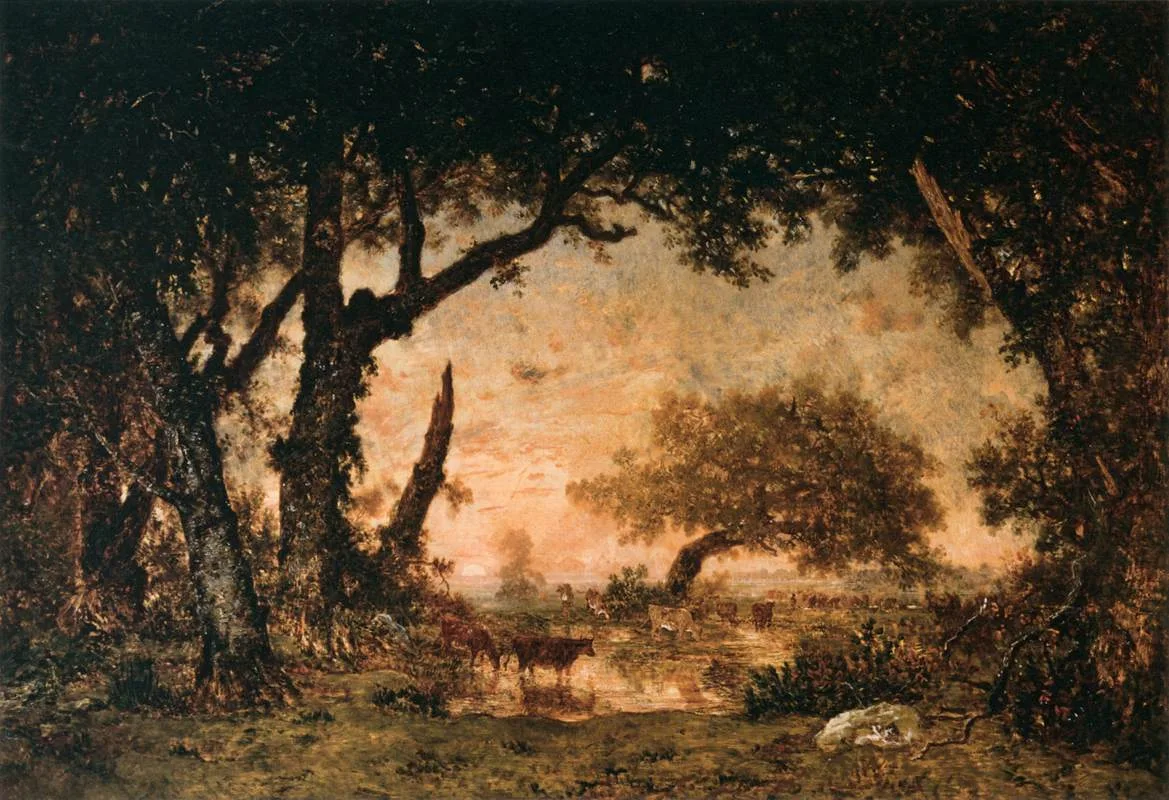
The argument Théodore Rousseau made to save the forest of Fontainebleau was not an environmental one. It could not have been: the word did not yet carry the meaning we give it. His argument was aesthetic, and it worked.
In 1852, Rousseau and his friend the critic Alfred Sensier wrote to the Duc de Morny, then Minister of the Interior, on behalf of "all the artists who paint the forest". For decades the forest administration had been felling the old oaks and beeches of Fontainebleau and replanting with fast-growing conifers: commercially rational, and in Rousseau's view a kind of destruction for which there was no adequate word. He did not appeal to ecology. He appealed to art. These trees, he argued, are to landscape painters what the works of the masters are to other artists: irreplaceable models, accumulated over centuries, impossible to manufacture and impossible to replace. Destroying them is destroying a school.
The argument landed. In 1853 the administration withdrew 624 hectares of old woodland and rock from felling, from the Bas-Bréau to the Gorges d'Apremont. They were called the séries artistiques, artistic series: the vocabulary of painting pressed into the service of protecting a landscape.
Rousseau kept pushing. He had been living in Barbizon since 1847, and the forest was the subject and the engine of his entire practice. He knew every boulder, every clearing, every tree the administration's axe was approaching. Yet the Barbizon painters were not celebrated in 1852: Rousseau himself had been turned away by the Salon jury so consistently from 1836 onwards that he was known as le grand refusé. But by the late 1850s the forest paintings had begun to sell, and the collectors who bought them had ears in the right places.
On 13 August 1861, an imperial decree withdrew 1,097 hectares of the Fontainebleau forest from all exploitation, 542 of old woodland and 555 of rock, on the grounds of their artistic value. It is often described as the first nature reserve in the world: Yellowstone would not be created for another eleven years. The fight went on after him. In the 1870s a Committee for the Artistic Protection of the Forest, supported by Victor Hugo among others, and then George Sand's intervention, took up the cause to defend and extend the reserve.
Rousseau did not see what followed. He died in Barbizon in December 1867, long before the idea travelled, through France and far beyond, into the whole architecture of nature-protection law that now covers a significant share of the planet. He is buried in the cemetery at Chailly-en-Bière, beside Millet.
What remains in the forest is what he fought for: the old oaks of the Bas-Bréau, the sandstone of the Gorges d'Apremont, the clearings where the morning light falls the way it fell when he set up his easel. The painters' paths are still there, marked now in blue. The forest has not changed much. That is precisely the point.