Landscape
The Gleaners and What They Were Looking At
On Millet's most unsettling painting, the field it came from, and the argument it made.
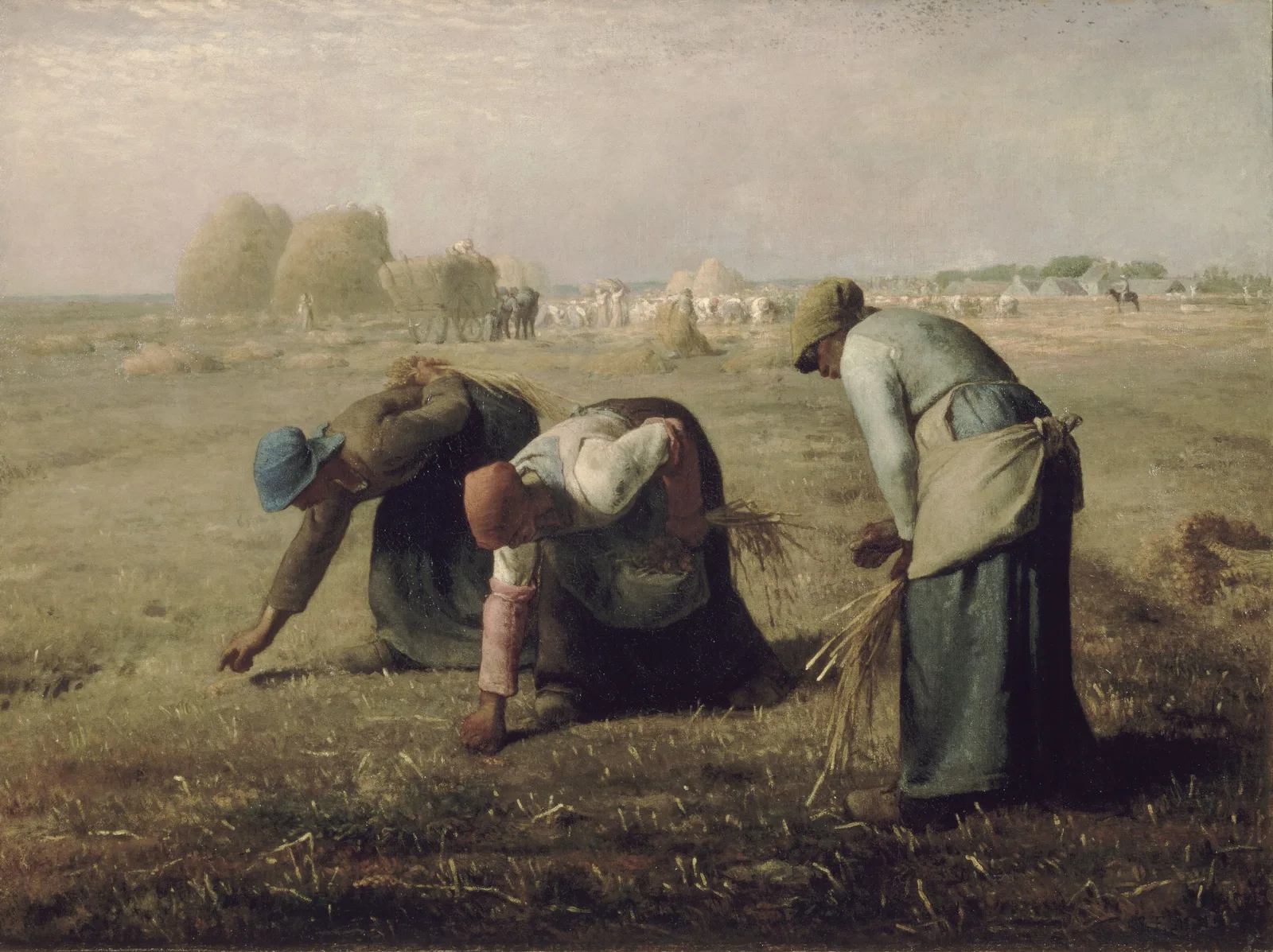
The plain behind The Gleaners still exists. It lies just outside the village, stretching between Barbizon and its larger neighbour Chailly: the same broad farmland that Jean-François Millet walked across again and again during the years he lived here. When I walk out there in late summer, after the harvest, it is not difficult to see what he was looking at. The plain is wide, the sky is wide, and if there are figures bent over the stubble in the middle distance, the eye finds them almost before anything else.
Millet finished the painting in 1857 and showed it at the Salon that year. The response was immediate and hostile. One critic claimed to see the riots and scaffolds of 1793 looming behind it. The bourgeoisie, still unsettled by the Revolution of 1848, read it as a provocation: three poor women made monumental, at a scale usually reserved for gods and emperors, bending over a field that belonged to someone else.
What the painting shows is gleaning: the long-established right of the poor to collect what the harvesters left behind, the fallen stalks and loose grain. In the background, haystacks rise behind the organised labour of paid workers. In the foreground, three women move slowly through what remains. The structure of the scene is explicit: the further back you look, the further you are from necessity.
Millet was not a political agitator. The son of Norman peasants, and deeply religious, he settled in Barbizon and stayed. He painted what he saw. The gleaners were real women, from the fields around Chailly, doing a real thing. His argument, if it can be called that, was simply that this labour deserved the same scale as a battle or a saint.
The painting did not sell well. Millet, often short of money, let it go after the Salon for 3,000 francs, below his asking price, and tried to keep the figure secret. In 1889, long after his death, it sold at auction for 300,000 francs; Madame Pommery bought it and gave it to the French State. It now hangs in the Musée d'Orsay. The plain outside Barbizon had not changed. The argument about who it belonged to, and who deserved to be seen within it, apparently had.
I think about that gap sometimes when I'm out there: between what the work cost to make and what it eventually became worth, between the hostile Salon and the 300,000 francs, between the women bending in the field and the painting now hanging in Paris. The land is still there. It is the most stable thing in the whole story.
Related essays
Places in this essay