Village life
The House of the Crime
On the morning of 6 September 1893, an elderly Swiss painter was found dead in his house on the Grande Rue. Three years later the same house reopened under a name borrowed from Rousseau: the Hôtel des Charmettes.
The Swiss painter Albert Landerer settled in Barbizon around 1876, in a walled house on the Grande Rue. He never tried to compete with the landscape painters: he painted musketeers, battles, and the martial memories of his native Switzerland. By the early 1890s he was a very deaf and very trusting old man.
It was then that a servant from Switzerland entered his household: Nothburgia Binder. She already had an adventurous life behind her: married in Buenos Aires and widowed soon after, she had inherited her first husband's fortune. A month after she arrived, the painter was talking of marrying her. His friends kept their distance, so much so that he could not find a single one of them to witness the wedding, held in October 1892. He was over seventy-five; she was not yet thirty. One will in her favour followed another, confirmed by a deed of gift before a notary.
A tradesman from Fontainebleau, Jean Lacampagne, had come to the house to do plumbing work. He also kept a café in town. He became the young wife's lover, and everyone knew it. Almost every night he crossed the forest by bicycle, left it at the gate of the property and came in through the garden. Landerer suspected nothing: he made Lacampagne his friend, and even the executor of his will. Lacampagne placed his own daughter, Hélène, aged fifteen, in the house as a servant.
At half past eight on the evening of 5 September 1893, Mme Landerer, who had been staying in Fontainebleau for several days, walked into a draper's shop on the rue Grande with Lacampagne. She asked for a complete mourning outfit. She was told it would take forty-eight hours to make. She insisted she wanted it at once.
The next morning it was Hélène who found the body. Albert Landerer lay dead in his bed with three revolver bullets in his head, all on the left side. At the foot of the bed, on the right, someone had placed an old, rusted revolver. The staging fooled no one: the painter was not left-handed.
The comings and goings of that morning settled the suspicions. Alerted by his son, Lacampagne hurried over by carriage with Mme Landerer, then left at once, alone, to see a notary in Fontainebleau. The investigation found he had bought a revolver in Paris four days earlier. On the morning of the murder he had written to the shop asking them to leave the purchase off his bill, so that his wife would not find out. He later claimed he had thrown the gun into the Carp Pond at Fontainebleau.
The case was tried at Melun on 25 and 26 May 1894. Both accused denied everything, even the affair, even the mourning outfit. The jury deliberated for half an hour and found them guilty, with mitigating circumstances. Lacampagne and the widow Landerer were sentenced to hard labour for life, and the courtroom applauded the verdict.
In the autumn of 1894 the painter's furniture went to auction. It held a surprise: a satchel containing a hiding place the killers had never found, with 3,100 francs in banknotes and a gold snuffbox holding a ring. Lacampagne, by then, had just arrived at the penal colony in New Caledonia.
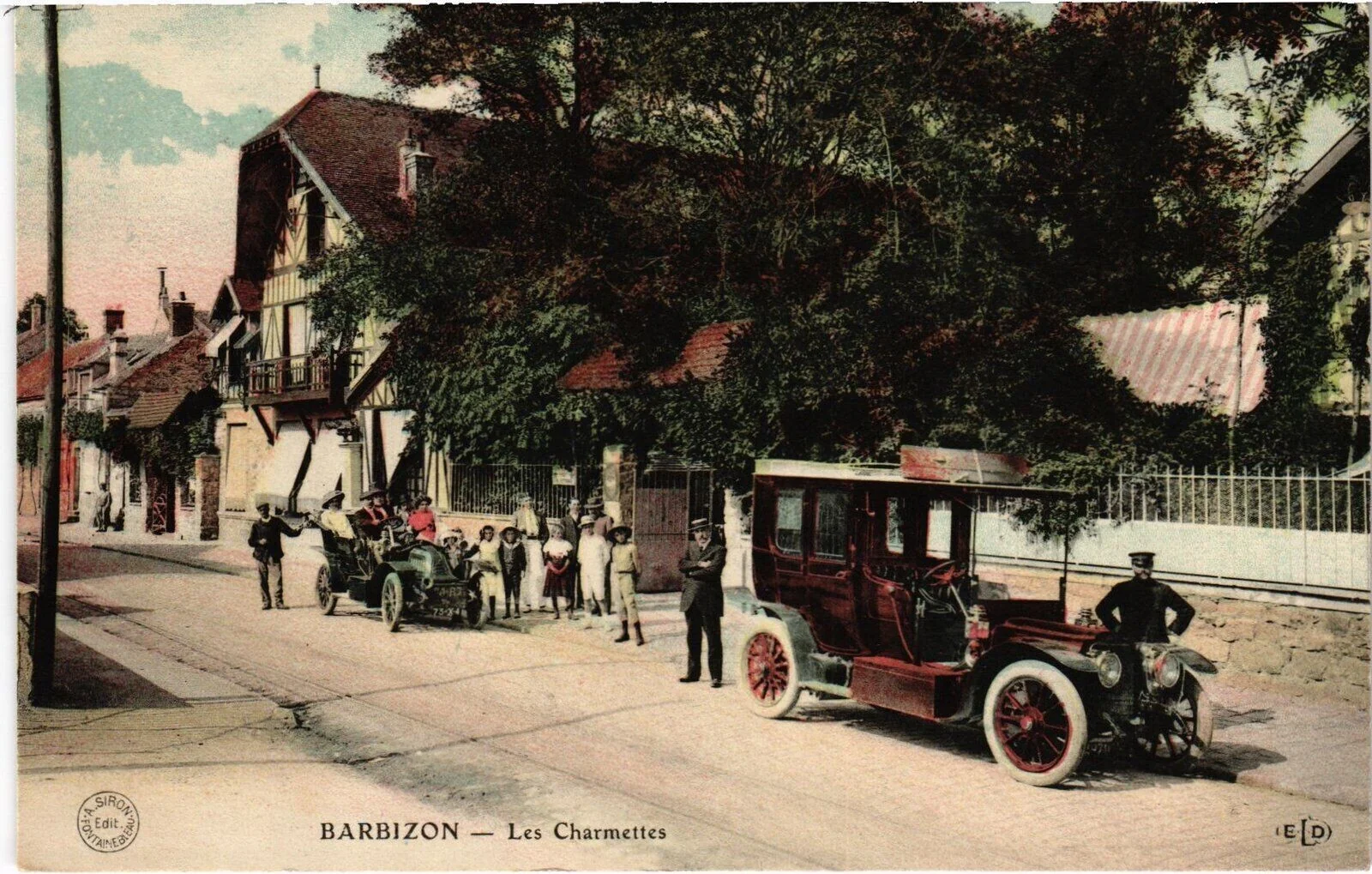
That left the house. In the village it was now known only as "the house of the crime". In the summer of 1895 the court put it up for sale: a small house with a painter's studio upstairs, on a walled plot of about 2,200 square metres. The sculptor Marqueste won it at first, but Théodore Duhamel outbid him and took it. The new owner, judging it would be hard to let, decided to turn it into a hotel. He gave it a poetic name: Les Charmettes, after the hamlet in Savoy where Jean-Jacques Rousseau lived with Madame de Warens. By September 1896 it was already hosting a musical evening.
In the spring of 1897 a Swiss, Emile Schaller, took the business over. His family would run it for more than half a century, and in 1902 the Hôtel des Charmettes received the first telephone in Barbizon open to the public. Of the house of the crime, soon nothing remained but the name of a country retreat.
Related essays
Places in this essay