Art
How the Forest Became a Picture
Corot, the practice of painting from the motif, and what Barbizon made possible: looking at one place for a long time, in a light that never stops changing.
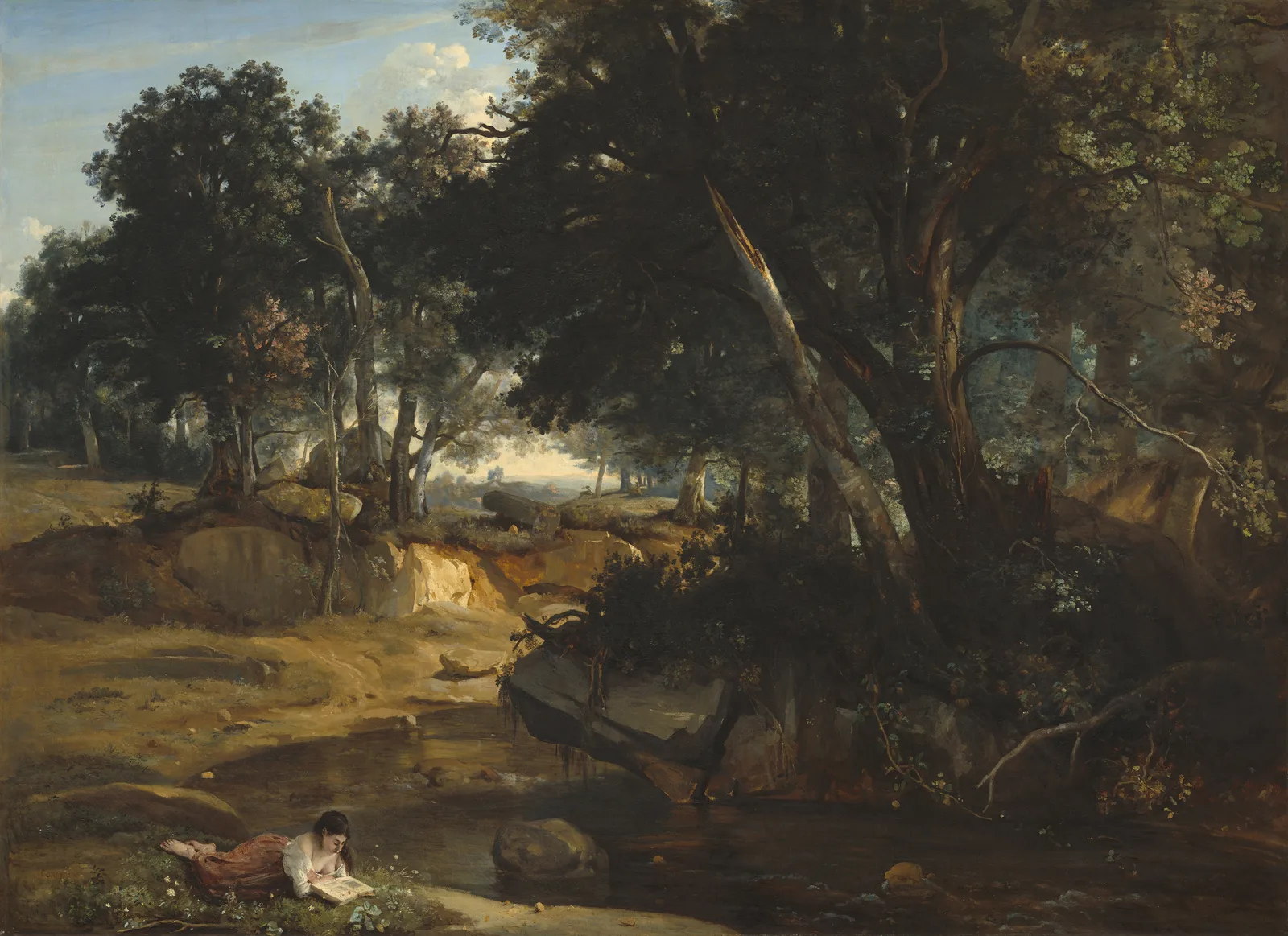
Before Barbizon, a landscape painter worked like this: you went outside, made sketches and notes, then returned to the studio and composed a finished painting from memory and convention. The finished picture was rarely the place itself: it was an idea of place, arranged according to inherited principles, with balanced compositions, a few figures for scale, and a sense of resolution. The landscape was a construction. Nobody expected otherwise.
What changed, gradually, across the first half of the nineteenth century, was a growing conviction that this construction was an evasion. That painting might instead look directly at the actual light and weather of a specific place, and try to register it without mediation.
Camille Corot was one of those who pursued this most seriously in France. He came to paint in the Fontainebleau forest in the 1820s, making open-air studies that were not simply preparatory sketches but works attentive to a particular light at a particular hour. He had recently left the drapery trade his father had placed him in. His teacher, Achille Etna Michallon, had advised him to render what he saw with the greatest possible fidelity. Corot took this literally.
The technical conditions were not easy. Before the collapsible paint tube was invented in 1841, pigments were stored in animal bladders that dried out and split. Portable easels existed but were cumbersome. Working outdoors meant accepting what the studio kept out: wind, shifting light, cold. The resulting works often looked unfinished to academic eyes, insufficiently composed. They were not made for the Salon in any case.
But the Forest of Fontainebleau was particularly suited to this way of working. Its light is moderated by the canopy. The sandstone outcrops and old oaks stay put. The distances are contained: a painter is never far from shelter, or from the village. In 1849 the railway reached Fontainebleau, making it possible to leave Paris in the morning and be in the forest within hours.
What accumulated over the following decades was not a theory but a practice: sustained attention to a specific place. Corot, Rousseau, Millet and Daubigny returned again and again, building a familiarity with this forest and this light. Théodore Rousseau studied individual trees across the seasons as if they were portraits. Millet walked the same fields over and over. The work was not about landscape in general, but about this place, under these conditions, at this moment.
That accumulation is what Barbizon made possible. Not a formal school: the painters here never fully agreed on principles. But a shared commitment to observation. The generation that followed, Claude Monet included, extended this approach and made it central to modern painting. But the habit of looking closely, outdoors, at a specific place had already taken root here.
When I walk into the forest early in the morning, before anyone else is there, it sometimes seems that the attention required to paint something well, standing in front of it in changing light, is not so different from the attention required to live in a place rather than pass through it. Barbizon rewarded both.
Related essays
Places in this essay